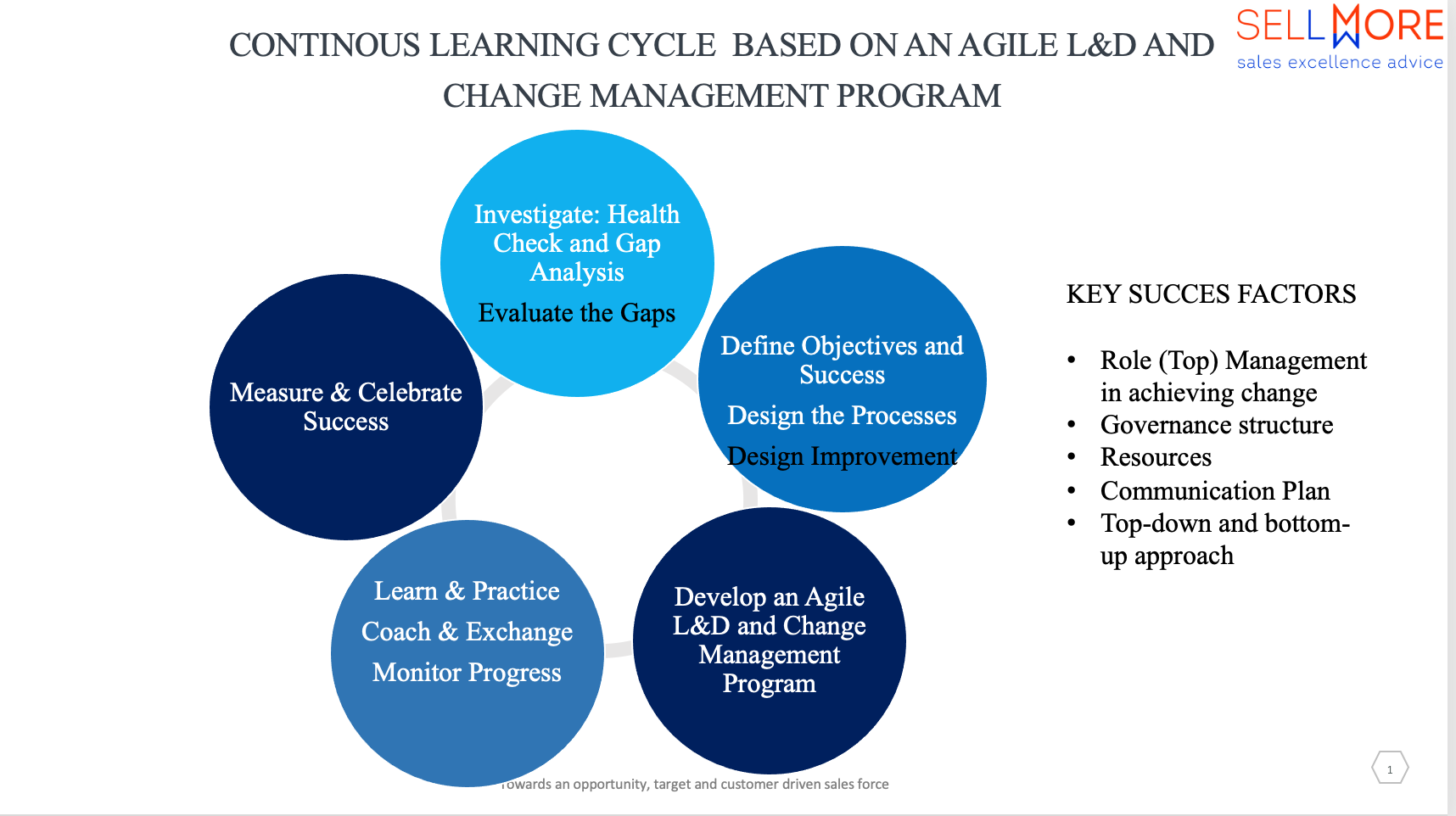
So, we built our commercial processes, defined the roles, defined success, ‘what excellence looks like’, defined (leadership) capabilities linked to it, set up a Commercial Excellence Change plan which includes all the elements I wrote about last time….
And now?
How can we get teams which are motivated to change and further improve?
Managers who lead by example and lead the change?
How to create a continuous learning environment?
This journey was like ‘Building the bridge as you walk on it’ (Robert E. Quinn), we didn’t know everything when we started, we had to deal with uncertainty and drove sometimes on a bumpy road….
And remember the examples of our objectives:
How can we move from a transactional way of selling to value selling?
How can we get sales teams which are opportunity, action, customer and data driven?
How can we get most out of our contacts with existing customers and how can we get new qualified leads in which are turned into new customers?
How can we avoid our teams negotiating too quickly on price?
How can we make sure that CRM and other Sales Enablement tools support success? Are effectively used by commercial/sales teams and leaders?

Last time, I spoke about the importance of an agile L&D and Change Management program. What do I mean with agile? My experience with this is as follows:
- Such a program is most effective when it supports all what is defined in ‘what excellence looks like’. When we first started with this in AIRFRANCE-KLM back in 2012, this was new to us. Till then, we had fixed sales trainings, like ‘negotiation skills’ and many projects at HQ level like ‘from farming to hunting’. Our L&D department at the time, under the leadership of Anke Wijnen, realized this needed to change because we didn’t see improvements of sales teams and leaders which lasted. Anke took the initiative to change the ‘KLM Business Campus’ training department to a L&D department focused on customer needs (us the Business) based approach. L&D and the Business co-created an agile L&D program which served not only to practice and improve on the ‘what excellence looks like‘ and the (leadership) capabilities linked to it, but also how to support change and make change really ‘stick’, how to achieve different behaviour which lasts.
Whatever L&D and change management program you put in place, some key learnings from 8 years designing and implementing commercial and digital transformation programs:
- Start with Top (Commercial) Management. Or better, when they take the initiative for commercial and digital transformations. Why? They need to lead the change, lead by example, free up budgets and resources, actively communicate on the ‘why’, ‘what’, ‘how’, ‘when’ to their MT and the whole organisation. Furthermore, and very important, they need to incorporate the objectives of the change program, the activities linked to what defines success and the progress made in their priority setting, in their meeting structures. We all are very busy and if this is not taken care of, other projects or ‘running the business’ (continue working as always) will get higher priority. Let them participate in a few workshops made for their Sales Management and the ones for their sales teams so they get deep insight in ‘what excellence looks like’, where the challenges are and what they can do from their side to solve them. Important as well they coach their commercial leadership on improving their leadership capabilities. Do not assume they are able or will do this automatically, they are also people and its very well possible they have a growth area here as well.
- Next: Rest Commercial Leadership. Depending on the size of the organisation you can have several layers before you reach the managers who directly have a sales team they manage. Positions not directly leading a sales team: same role as described in top management and additionally, they need to coach-the-coach, to monitor progress made on their leadership capabilities. In workshops/meetings, prepare them for this role, let them ‘set the scene’, and discuss with their managers how and what gaps they see between current and ‘what excellence looks like’ state, what opportunities and obstacles they see to change/further improve themselves and their teams. The same activity for the sales managers with their teams. When we first ask our managers to do this, this was new to them, so it is important to prepare them well for these Masterclasses.
- Before you start training on ‘what excellence looks like’…..
- I highly recommend to first start with kick-off sessions with your commercial/sales teams. Put your Commercial/Sales Management in front of the troops. Let them co-lead these interactive sessions which are meant to highlight the sense of urgency, reasons why and what needs to change and improve, how this will be done, what is needed from the teams and when things will be organised.
- Create a sense of urgency and at the same time a lot of energy. Ask top management to come over for a talk as well or tape a video (when you are talking about worldwide teams) on the importance of the commercial and digital transformation and the investments made in people and technology.
- In these sessions you can anticipate on hidden resistance to change by sales teams, like: ‘our workload is already sky high and you want us to spend more time on preparing customer visits/meetings? We do not have time for that’. Or ‘We have been working like this for the past 20 years, was all we did till now wrong?’ Or ‘The commercial and digital transformations doesn’t work if problems at other departments are not solved first’.
- Take away concerns, like the concern the program is meant as a selection process, the concern that Sales will not be needed anymore in the near future………..overshadows the positive message to further improve and invest in the teams. Why would a company actually invest a lot of money in improving their teams if they would make them redundant…? Logic and emotions often are quite different, yet important to acknowledge. If not discussing these concerns, this will/could stay as a negative sentiment in the teams, and we want to create motivation and energy, don’t we? On the other side, do not hide things and be clear. For the ‘what excellence looks like’ role, most probably new competences/capabilities and new behaviours are needed. In the end, it could be that there is no fit and match anymore with the (new) requirements of the job. As in any other HR process, a search should then be made for alternative roles. Be clear that this is NOT the objective of the commercial and digital transformation, but HR ‘business as usual’.
- Workshops L&D and change management program: practice on ‘what excellence looks like’. This can be anything (see other blogs on examples) and having real customer cases to practice new concepts and methodologies works best in my experience. As mentioned, Commercial/Sales Management should participate in their teams sessions and next to this I would design workshops for Sales Leaders only on how to coach, develop and improve their teams on ‘what excellence looks like’ and on developing sales teams capabilities linked to it.
- Support a continuous learning environment. Based on measuring success, monitoring progress made, celebrating success and exchanging best practices (also for Sales Leaders!), L&D modules were made to support areas which needed further development, both for sales/commercial teams as leaders. For Example:
- Active listening and asking the right questions: A very important skills which is needed to find out customer needs, everything about the customer business before you can make a good value proposition the customer.
- Analytical Skills: during the commercial transformation process we found out that many sales reps needed support drawing the right conclusions from all kinds of info and data when preparing for sales visits/customer contacts. Special workshops were made based on real customer cases to support and further improve them on this subject matter. So called ‘vitamin’ workshops were made to guide and improve teams themselves on the subject.
- Coaching skills: when we started in 2012, Sales Managers realized they needed to start coaching their teams instead of only ‘managing on results/output’, if they really wanted to improve the quality of their teams. Really wanted to change them from transactional sellers to value sellers.Specific workshops were developed to improve their coaching skills using/practising for example with the GROW model, with identifying their team members position on the ‘Skill-Will matrix’ and what leadership approach suits best to that or with their team member’s position in the ‘Change Curve’ and how to effectively help them through the transformation process.
- Based on monitoring individual progress made on ‘what excellence looks like’ and (leadership) capabilities needed for that, an L&D program (sounds heavy, but doesn’t need to be) can be put in place to support individual development for both teams as leaders.
Next time I will write about my experience and examples of situational, on the job learning which proves to be most successful in achieving real change (the 70-20-10 model of Michael Lombardo and Robert Eichinger)